Watch World Cup 2026 online free USA Canada Mexico streaming
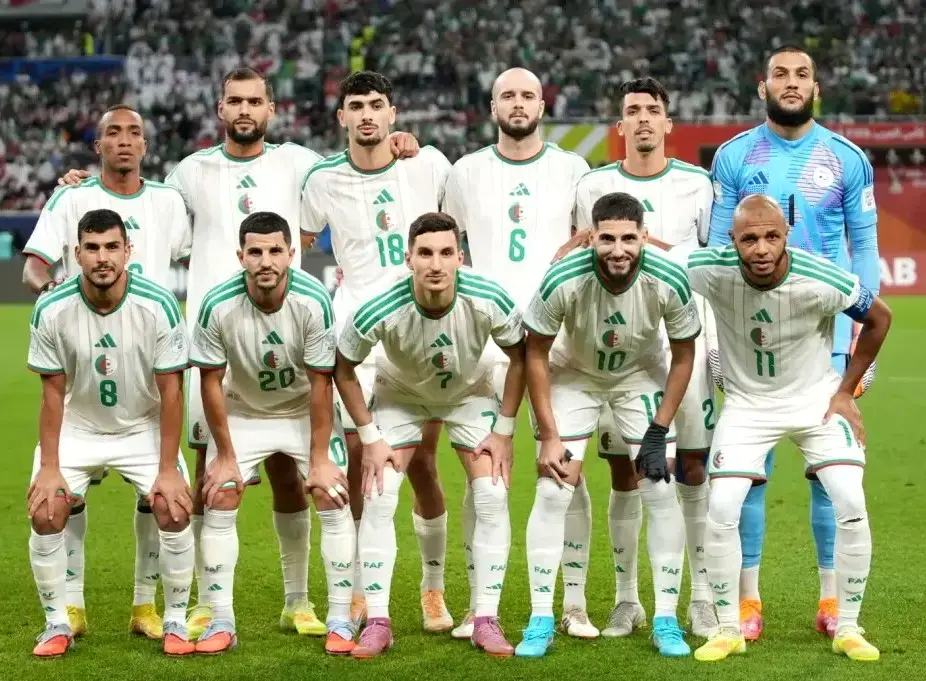
The Desert Warriors’ quest to defend their Arab crown ends in premature devastation, leaving questions about the future of the “A'” squad and the tactical direction under Madjid Bougherra.
The journey of the Algerian national football team (Les Fennecs) in the FIFA Arab Cup 2025 has come to an abrupt and painful conclusion. Entering the tournament in Qatar as the defending champions and heavy favorites, Algeria’s campaign was cut short in the Quarter-Finals, sending shockwaves through the streets of Algiers and the stands of Doha. despite a blistering start to the group stages, including a 5-1 demolition of Bahrain, the team failed to replicate the grit and “Grinta” that defined their 2021 triumph. This comprehensive analysis dissects the exit, the player performances, and the implications for Algerian football as they look toward the 2026 World Cup.
Algerian football players in green kits looking heartbroken on the pitch after losing a match in a modern Qatar stadium at night, cinematic lighting, realistic style
When Madjid Bougherra announced his squad for the 2025 edition of the FIFA Arab Cup, the expectation was not just to participate, but to dominate. The memory of the 2021 victory—where Algeria defeated Tunisia in a dramatic final at the Al Bayt Stadium—was still fresh. That tournament had cemented the “A'” team (composed largely of players based in Arab leagues and domestic talent) as a force equal to the main squad.
For the 2025 campaign, the pressure was immense. With the tournament once again hosted in Qatar, effectively a “home ground” for Algeria due to the massive diaspora community, anything less than a semi-final appearance was considered a failure. The squad featured a mix of experienced veterans like Yacine Brahimi, Islam Slimani, and Youcef Atal, alongside rising stars like Mohamed Amine Tougai and Houssem Mrezigue. On paper, it was a championship-caliber team.
However, football is rarely played on paper. The burden of the “Defending Champion” tag often weighs heavy, and for this Algerian side, the transition from “underdog warriors” (2021) to “undisputed kings” (2025) proved psychologically challenging. The hunger that defined the 2021 run seemed replaced by a burden of performance that stifled creativity when it mattered most.
Algeria’s tournament began with a deceptive brilliance. The opening fixtures suggested a team firing on all cylinders. The highlight was undoubtedly the 5-1 thrashing of Bahrain. In that match, Les Verts looked unstoppable. The midfield, orchestrated by the evergreen Yacine Brahimi and the resurgent Yassine Benzia, flowed with liquid geometry.[1]
Yet, analysts noted cracks even in these victories. The defense, while not heavily tested, showed lapses in concentration during set-pieces. The aggressive high line played by Abdelkader Bedrane and Mohamed Amine Tougai left gaps that better teams could exploit. The 5-1 scoreline masked the fact that for 20 minutes, Bahrain found pockets of space behind the Algerian full-backs. This “false positive” result perhaps led to a degree of complacency entering the knockout rounds.
The Quarter-Final exit stands as the turning point where tactical rigidity met high-stakes pressure. While the group stages allowed for expression, the knockout phase demanded discipline and clinical finishing—two attributes that deserted Algeria on the fateful night.
Madjid Bougherra, known for his motivational skills (“The Magic”), struggled to adapt tactically when the opponent sat deep. Unlike the 2021 final where the game was open, the Quarter-Final opponent employed a low block, denying space to Youcef Belaili and Yacine Brahimi. Algeria dominated possession—often exceeding 65%—but it was sterile domination. The ball moved side-to-side (the dreaded “U-shape” circulation) without penetrating the central defensive zone.
Youcef Atal and Houari Baouche were tasked with providing width. While Atal offered his usual offensive spark, his defensive positioning was suspect. The counter-attacks that led to Algeria’s vulnerability often originated in the spaces vacated by the full-backs. In 2025, the transition defense was simply not quick enough to cope with the rapid breaks of the opposition.[2]
Despite having Islam Slimani, Algeria’s all-time top scorer, the team lacked efficiency in the final third. The reliance on crosses into the box became predictable. In the dying moments of the match, as Algeria chased the game, the composure evaporated. Shots were rushed, passes were overhit, and the distinct “Grinta” (fighting spirit) morphed into frustration.[2]
The exit forces a difficult conversation about the lifecycle of this squad.
The “Bougherra” Factor vs. The “Petkovic” Era
A fascinating sub-plot to this exit is the coaching dynamic. While Vladimir Petkovic leads the main squad for the World Cup qualifiers, Madjid Bougherra handled this tournament.[3]
Bougherra’s stock had risen meteorically after the 2021 Arab Cup and the CHAN performance. However, this 2025 exit may be his first major stumble. Critics will argue that his emotional reliance on the “old guard” (Slimani, Brahimi, Mbolhi/Chaal) rather than integrating younger talent from the Algerian Ligue 1 cost the team.
The disconnect between the “A” team (Petkovic’s high-intensity European style) and the “A'” team (Bougherra’s more patient, possession-based style) was evident. The players who transition between both squads looked caught between two different philosophies.
The atmosphere in Doha, usually a cauldron of noise for Les Fennecs, turned somber. The Algerian diaspora in Qatar had turned out in the thousands, creating tifos and chants that rivaled any World Cup match.
Social media platforms like X (formerly Twitter) and Instagram exploded with the hashtag #DzFoot trending globally. The sentiment ranged from anger to resignation. “End of an era,” one viral tweet read, referring to the likely final tournament for legends like Slimani and Brahimi. Others pointed fingers at the FAF (Algerian Football Federation) for failing to refresh the squad, arguing that the loyalty to the “2019/2021 Heroes” has become a hindrance to progress.[4]
While the exit from the FIFA Arab Cup 2025 is a bitter pill to swallow, it may serve as a necessary wake-up call. The “A'” team is often the feeder for the main World Cup squad. The exposure of defensive frailties and the lack of a clinical finisher (beyond the aging Slimani) gives Vladimir Petkovic crucial data ahead of the final stretch of World Cup 2026 qualifiers.
Algeria must now pivot. The reliance on the “Golden Generation” of 2019 must end. The Arab Cup 2025 will be remembered not for the trophy that was lost, but perhaps as the moment the torch was finally forced to pass to the next generation. The talent is there—in the domestic league, in the academies, and in Europe—but the integration must be swift.
The dream of Doha 2025 is over, but the dream of the 2026 World Cup remains alive. The Desert Warriors have fallen, but they have risen from worse before.
| Player Name | Position | Age | Key Stat/Note |
| Islam Slimani | Forward | 37 | Oldest outfield player; Aerial threat neutralized in QF [2] |
| Yacine Brahimi | Midfielder | 35 | Captain; Most chances created in Group Stage |
| Youcef Atal | Defender | 29 | High attacking output; defensive gaps exposed [2] |
| Yassine Benzia | Midfielder | 31 | Breakout performer of the tournament |
| Mohamed Amine Tougai | Defender | 25 | Highest pass completion rate in defense [2] |
Related Search Trends: Algeria Arab Cup 2025 Highlights, Madjid Bougherra Press Conference, Riyad Mahrez National Team News, Vladimir Petkovic Reaction.
⁂